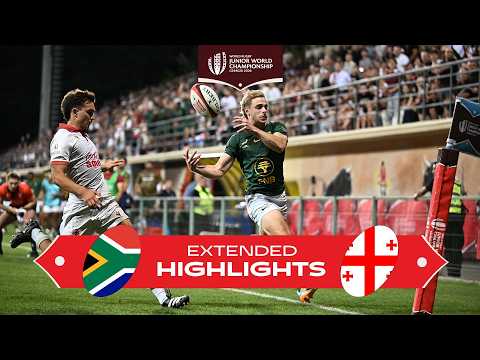
The dominant thread across coverage was the gap between the scoreline and the performance. SuperSport's report led with Foote's own admission that it "wasn't a pretty game by any stretch of the imagination," and both World Rugby highlight packages framed it similarly — one titling the contest a "grind" and the other flagging it as "tense." The consensus is clear: Georgia, playing in front of their home crowd, disrupted South Africa's attacking structure throughout and actually led early through Tabatadze's lineout set-piece try. The match only opened up through Georgian ill-discipline — three yellow cards, one upgraded to a 20-minute red — rather than Junior Bok dominance. Rugby365 specifically noted that even with a two-player advantage, South Africa couldn't breach the Georgian defence, which undercuts any reading of this as a comfortable win.
On individual performances, Rugby365 provided the detail the other sources didn't: Mnebelele's two lineout-maul tries steadied a wobbling ship in the first half, and Giliomee's quick-tap penalty score sealed the bonus point before Luke Cannon added a late fifth. Giliomee's overall contribution — try, three conversions, and the heads-up play to claim the fourth point — was the clearest individual thread across the substantive reports. Foote's post-match framing, carried by SuperSport, treated the result as a "wake-up call" rather than a milestone, pointing explicitly to the need to sharpen up before the Wales decider.
Every source with editorial content converged on the Wales fixture as the real story emerging from this one. With Wales having beaten both Georgia and Uruguay, the final pool game is effectively a semifinal qualifier, and Foote was unambiguous about that framing. The pre-match Rugby365 piece on the Rassie alignment camp adds context: this squad came in as defending champions off a 104-7 opening win, which makes the scrappiness against Georgia a more notable signal — and raises the stakes of what Foote himself called "knockout rugby" against Wales.